
CV writing tips Introduction
In a job market where every vacancy attracts hundreds of applications, a perfectly written CV isn’t optional—it’s essential. Your CV is the only tool you have to cut through the noise and convince a recruiter to call you for an interview. This guide compiles over 30 field-tested CV writing tips, covering everything from strategic tailoring and formatting to powerful content creation. Whether you’re a seasoned professional or just starting your career, these straightforward, actionable tips will give you the competitive edge you need. For a complete suite of ready-to-use CV templates and a step-by-step builder, explore the expert resources at LiveCareer’s CV tips page.
1. CV writing tips Tailor Every CV to the Specific Role
Generic CVs get rejected. Treat each job application as unique by aligning your CV directly with the job description. Scrutinise the advert for keywords—required skills, experience, and qualifications—and ensure your CV prominently reflects how you match those needs. This simple habit transforms your application from a mass-mailer into a targeted, compelling pitch.
2. Choose the Standard Reverse-Chronological Format
The UK market overwhelmingly prefers the chronological CV format. It lists your work history starting with your most recent role, making it easy for recruiters to scan your career progression at a glance. Stick to this classic structure unless you’re making a dramatic career change or have a very fragmented work history, in which case a skills-based format might be considered—though use it with caution, as it’s far less popular with hiring managers.
3. Design a Clean, Scannable Layout
Recruiters spend seconds on a first pass. Your CV must be visually inviting and easy to navigate. Set margins to one inch, use 1.15 line spacing, and double-space between sections. Stick to a professional, web-safe font like Calibri, Arial, or Garamond in 11–12 pt. Use bold text for section headings and job titles, but avoid underlining which can create clutter. Consistency is key—if you bold one job title, bold them all.
4. CV writing tips Stick to the Ideal CV Length
For most professionals, a one-to-two-page CV is perfect. If you’re a recent graduate or school leaver, aim for a single, crisp page. Mid-level professionals with several years of experience can confidently use two pages. Only senior executives, academics, or medical professionals with extensive publications and credentials should exceed two pages.
5. Remove Outdated and Unnecessary Details
Leave your full postal address off—your city and postcode area are enough today. Never include your date of birth, marital status, or a photograph; these invite unconscious bias and are not required on UK CVs. Also, skip the phrase “references available upon request.” It’s filler that wastes valuable space. Only provide references if specifically asked.
6. Build a Header That Commands Attention
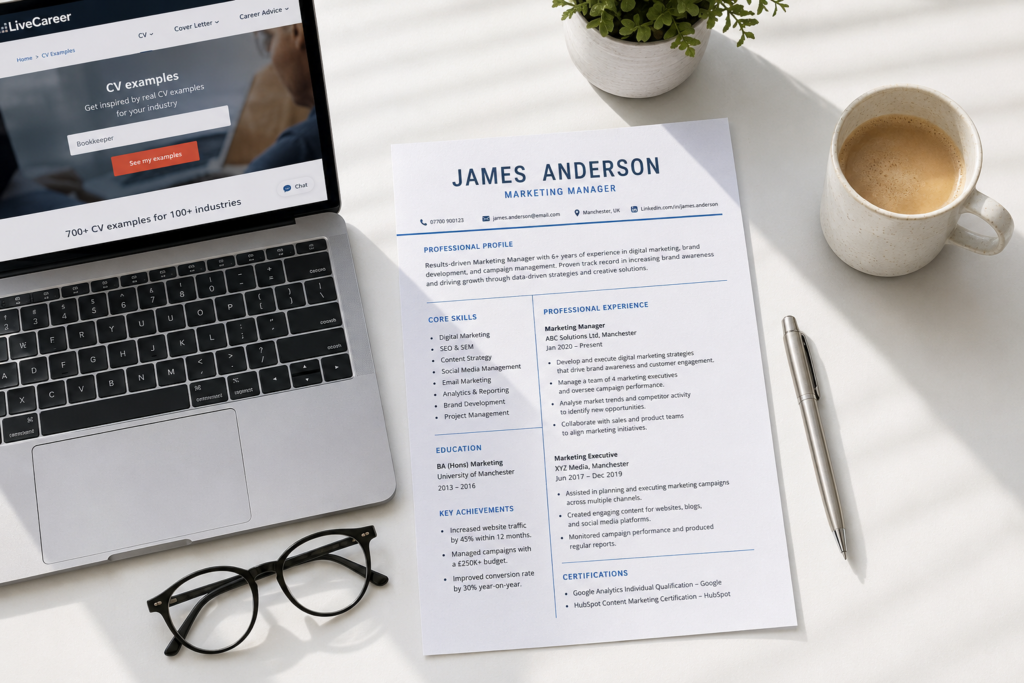
Your name is your headline, so make it 4–8 points larger than the body text. Below it, place your phone number, a professional email address (firstname.lastname based, not a novelty one), a clickable LinkedIn URL, and a portfolio link if relevant. Making these hyperlinks clickable shows tech-savviness and invites immediate engagement.
7. Open with a Powerful Personal Summary
This 3–5 line paragraph is your elevator pitch. It should answer three questions instantly: Who are you professionally? What value do you bring? What are you aiming to achieve next? Start with your job title and years of experience, follow with a key skill or achievement, and end with how you plan to contribute to the prospective employer’s success.
8. Perfect Your Work Experience Section
This is the core of your CV. List roles in reverse-chronological order, stating your job title, company, and dates. Use 4–6 bullet points per role, with more detail for recent or highly relevant positions. Begin each bullet with a strong action verb (managed, delivered, spearheaded) and use the PAR (Problem-Action-Result) method to frame your accomplishments. Quantify everything—numbers catch the eye.
Pro tip: Add a standalone “Key Achievement” line under a role for your most impressive result, such as: “Key achievement: Reduced customer complaints by 35% through implementing a new feedback system.”
9. Format Your Education Correctly
For university graduates, list your degree title, institution, and dates. If you’re still studying, put your expected graduation date. Recent graduates or students should move the education section above work experience and can add relevant modules or awards. For school leavers, include A-levels and note the number of GCSEs with grades in maths and English only (e.g., “9 GCSEs including English (Grade 6) and Maths (Grade 7)”). A first or 2:1 degree classification is worth mentioning; omit anything lower.
10. Build a Targeted Skills Section
Select 5–10 skills that match the job advert’s requirements. Always mix hard skills (e.g., Python, Budgeting, SEO) and soft skills (e.g., Leadership, Adaptability, Communication). For maximum impact, don’t just list them—add a brief proof sentence for each. For example: “Conflict Resolution: Mediated team disputes to restore collaboration without management escalation.” IT and communication skills are universally valued, so include them where genuine.
11. Add Extra Sections That Differentiate You
Stand out by including a carefully chosen additional section. Options include relevant certifications, languages (with proficiency level), key projects, volunteer work, or professional memberships. Hobbies and interests are worth including only if they demonstrate transferable skills or grit—like running marathons (dedication) or captaining a sports team (leadership).
12. Save and Send as a PDF
Always save your final CV as a PDF unless the job posting specifically asks for a Word document. A PDF preserves your careful formatting, fonts, and layout across all devices and operating systems, ensuring the recruiter sees your CV exactly as you intended.
13. Proofread with a Fine-Toothed Comb
Typos and grammar errors can instantly kill your credibility. First, read your CV aloud to catch awkward phrasing. Then run it through tools like Grammarly, and paste sections into the Hemingway App to tighten and simplify your language. Finally, ask a trusted friend or mentor to review it—a fresh set of eyes will often spot mistakes you’ve become blind to.
14. Pair Your CV with a Tailored Cover Letter
A cover letter is your CV’s strategic partner. It should not simply repeat your CV but amplify it. Open with a compelling achievement hook, provide concise evidence of how your skills will solve the employer’s problems, and close with a confident call to action inviting them to discuss the role further. Always customise the letter for each application.
15. Use a Professional Template to Remove the Guesswork
Don’t start from a blank page. A professionally designed template ensures your CV has an impeccable structure, modern font pairings, and ATS (Applicant Tracking System) compatibility—avoiding the rejections that poorly formatted homemade CVs often face. A quality builder also includes pre-written, industry-specific bullet points that you can customise in seconds, saving hours of effort while improving your final result.